 ings
GitHub Trending Today: AI Code Review, Web Guidance and Security — November 14, 2026
AI code review, modern web guidance, and security tools lead today’s GitHub Trending snapshot, alongside finance, collaboration, monitoring, and networking projects.
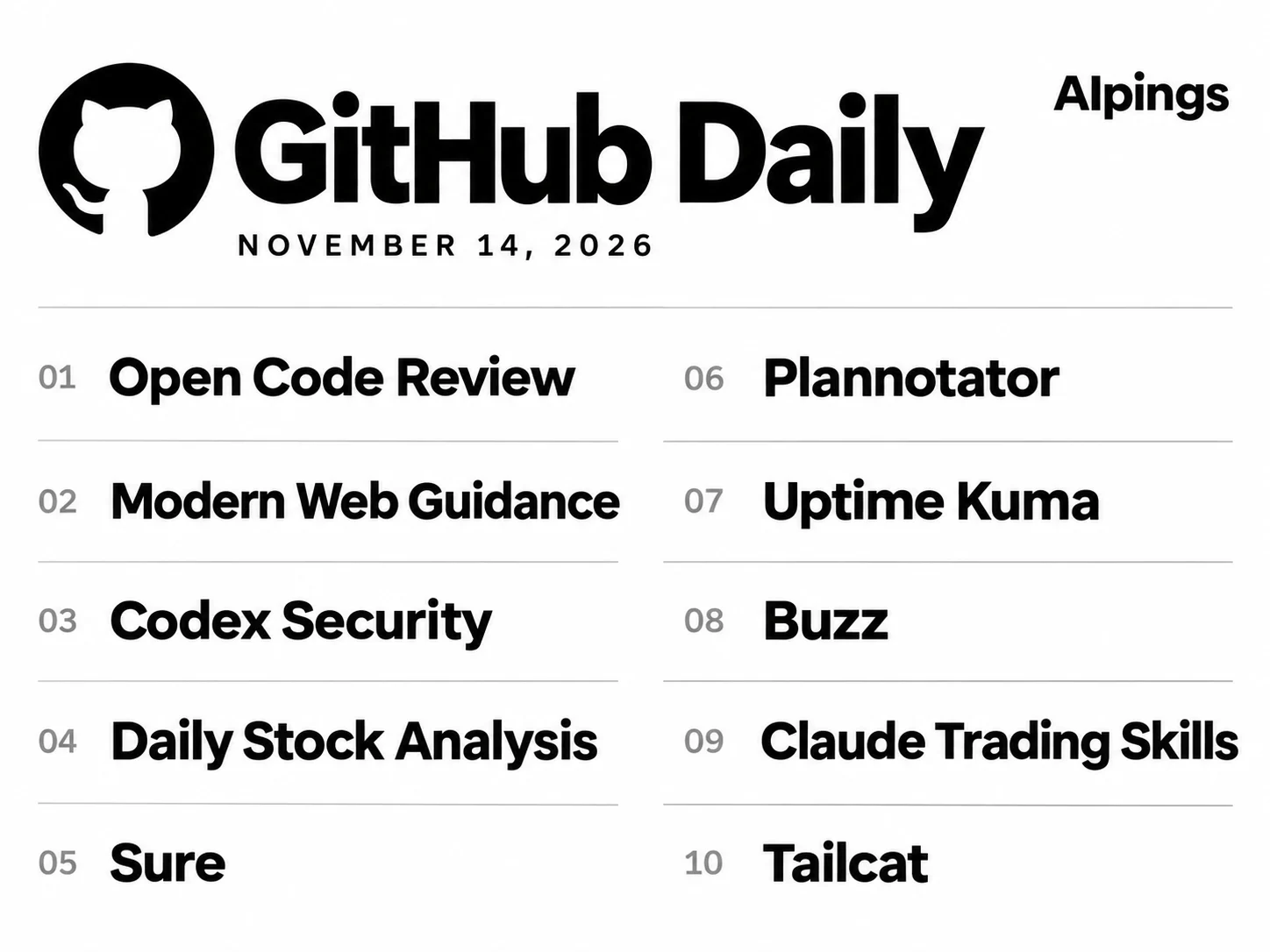
Three projects lead this GitHub Trending snapshot with tools for different stages of AI-assisted development: reviewing code, guiding agents toward modern web practices, and investigating security vulnerabilities. Alibaba’s Open Code Review, Modern Web Guidance, and Codex Security take the first three positions.
The rest of the top ten spans market research, personal finance, agent collaboration, service monitoring, and networking. Below is a quick overview, followed by a practical guide to what each project does, who it suits, and what to know before trying it.
Top 10 at a glance
Star counts as of November 14, 2026, 01:03 Beijing time.
Rank | Repository | Purpose | Total stars |
|---|---|---|---|
1 | AI code review | 50,361 | |
2 | Web guidance for coding agents | 4,478 | |
3 | Security scanning and fix verification | 12,955 | |
4 | LLM-powered stock analysis | 71,414 | |
5 | Personal finance management | 14,522 | |
6 | Plan and code review for agent workflows | 10,349 | |
7 | Self-hosted service monitoring | 93,729 | |
8 | Human–agent collaboration | 37,228 | |
9 | Market-research skills for Claude Code | 4,004 | |
10 | Command-line networking and port forwarding | 9,312 |
1. Open Code Review
Total stars: 50,361
Alibaba’s Open Code Review reads Git changes and produces review comments tied to specific lines. It can inspect surrounding code for context and also scan whole files when no useful diff is available.
Why it stands out: It combines programmed file selection and rule matching with an LLM agent, giving the review process an explicit structure while allowing contextual investigation.
Best for: Developers evaluating automated reviews for local changes or continuous integration.
Before trying it: The README requires Git 2.41 or later. Standard operation needs a configured model provider; delegation mode uses the host agent’s model and authentication.
2. Modern Web Guidance
Total stars: 4,478
Modern Web Guidance supplies coding agents with guidance on browser APIs, CSS, accessibility, performance, and compatibility. The trending repository contains the project’s source and evaluation tooling.
Why it stands out: Its task-specific guides help agents consider modern browser features instead of repeatedly reaching for older implementation patterns.
Best for: Frontend developers using AI assistants to build interfaces or modernize existing web code.
Before trying it: The documented installation entry point uses npx. Check each proposed browser feature against your product’s supported browsers.
3. Codex Security
Total stars: 12,955
Codex Security offers a CLI and TypeScript SDK for scanning code, investigating potential vulnerabilities, generating patches, and verifying fixes. Scans can target a repository, selected paths, or Git changes.
Why it stands out: Its documented workflow connects vulnerability discovery with validation and fix verification, with saved reports for subsequent review.
Best for: Developers and security teams building repeatable code-security investigations.
Before trying it: Setup requires a supported Node.js version, Python 3.10 or later, and authentication. Review the evidence and coverage limits in each report.
4. Daily Stock Analysis
Total stars: 71,414
Daily Stock Analysis combines market data, news, and large language models to generate stock-analysis reports and dashboards. Users can track a watchlist and receive results through messaging services or email.
Why it stands out: Scheduled runs and automated delivery bring information collection, analysis, and distribution into one recurring workflow.
Best for: Users who want a configurable routine for researching and following selected stocks across markets.
Before trying it: Configure a model provider, watchlist, and notification channel. Data-source and model-service availability or charges depend on the services selected.
5. Sure
Total stars: 14,522
Sure is a community-maintained personal finance app that continues the archived Maybe Finance project. Its dashboard brings together cash flow, net worth, and spending.
Why it stands out: It combines a broad financial overview with a self-hosting option, giving users a way to run the application on their own infrastructure.
Best for: Users comfortable managing a self-hosted finance app, and developers exploring a personal-finance codebase.
Before trying it: Docker self-hosting is documented. Plan for deployment, backups, and updates; the repository uses the AGPLv3 license.
6. Plannotator
Total stars: 10,349
Plannotator provides a workspace for reviewing agent-generated plans, annotating content, and inspecting code. Feedback can be collected and sent back to the coding agent.
Why it stands out: It makes human review a concrete step in the agent workflow, with comments attached to the material being discussed.
Best for: Developers reviewing larger AI-assisted changes and teams that need to discuss plans before implementation.
Before trying it: Setup varies by coding agent. Check the relevant integration instructions and the chosen sharing method before distributing plans.
7. Uptime Kuma
Total stars: 93,729
Uptime Kuma is a self-hosted tool for monitoring website and service availability. It supports checks including HTTP, TCP, Ping, and DNS, with notifications and status pages.
Why it stands out: It brings service checks, outage notifications, and status reporting into one dashboard, with multiple notification integrations.
Best for: Site owners, developers, and operations teams managing websites, APIs, or internal services.
Before trying it: It needs an always-running host; Docker deployment is documented. Configure monitoring targets and notification channels, then test alert delivery.
8. Buzz
Total stars: 37,228
Buzz is a self-hostable collaboration workspace where people and AI agents share rooms. Conversations, code patches, reviews, and workflow events become part of a searchable record.
Why it stands out: People and agents use a shared identity and event model, making agent activity part of the same traceable collaboration history.
Best for: Development teams experimenting with agents as participants in day-to-day project collaboration.
Before trying it: A self-hosted setup requires deploying the workspace and relay. Agent identities and channel memberships need to be configured for the intended tasks.
9. Claude Trading Skills
Total stars: 4,004
Claude Trading Skills provides reusable skills for market analysis, technical charting, economic calendars, stock screening, and strategy research inside Claude Code.
Why it stands out: Users can select skills for specific research tasks and combine them into a more structured, repeatable workflow.
Best for: Investors, analysts, and developers who already use Claude Code and want task-specific research tools.
Before trying it: Install the selected skill folders and check their individual dependencies and data requirements. Setup requirements vary by skill.
10. Tailcat
Total stars: 9,312
Tailcat is a Netcat-style command-line networking tool built on Tailscale’s data plane without its control plane. It supports piping data between machines and tunneling or forwarding TCP ports.
Why it stands out: Its temporary addressing and command-line interface offer a direct way to connect machines and reach services through a tunnel.
Best for: Developers and system administrators handling remote debugging, data pipes, or temporary service access.
Before trying it: It is a command-line tool. Check the server/client setup, target ports, and listener binding addresses for the intended connection.
Data and sources
Source: GitHub Trending, Today, with no programming-language or spoken-language filter. Captured on November 14, 2026, at 01:03 Beijing time (November 13, 17:03 UTC). This edition reflects that snapshot, rather than a completed calendar-day report.
The table preserves GitHub’s displayed order and includes the first ten of twelve repositories in the captured response. Stars are cumulative totals at capture and may change afterward; the list has not been reordered by star count.
Descriptions and prerequisites are based on the repositories’ published documentation. This is a source-based overview, not a hands-on test. Without a previous snapshot for comparison, this edition makes no claims about rank changes, first appearances, or causes of popularity.
- GitHub Trending — daily snapshot, November 14, 2026
- alibaba/open-code-review — official repository
- GoogleChrome/modern-web-guidance-src — official repository
- openai/codex-security — official repository
- ZhuLinsen/daily_stock_analysis — official repository
- we-promise/sure — official repository
- backnotprop/plannotator — official repository
- louislam/uptime-kuma — official repository
- block/buzz — official repository
- tradermonty/claude-trading-skills — official repository
- tailscale/tailcat — official repository