 ings
DeepSeek Opens Its App Features to Developers With Expanded API Suite
DeepSeek brings search, document processing and voice tools to its API platform, with integrated chatbot features and standalone endpoints for developers.
The update integrates search and document tools into existing APIs, while offering standalone interfaces for OCR, speech recognition and speech generation.
DeepSeek announced on November 13 that it is opening the capabilities behind its consumer chatbot through an expanded suite of application APIs. Developers can now combine model inference with web search, file input, URL reading and voice tools to build applications with functionality similar to the DeepSeek app.
Search and File Processing Join Existing APIs
The integrated features currently support V4.1-Flash, accessed as deepseek-flash, across the Messages, Responses and Chat Completions APIs. Developers enable the relevant parameters, while DeepSeek handles tool execution and context assembly on its servers.
With thinking mode disabled, the model can search the web or images as needed and answer with citations. With thinking enabled, it can search and read links across multiple reasoning steps. File input supports PDFs, Office documents and images, while a URL-reading tool retrieves pages linked in user messages. These capabilities are detailed in DeepSeek's official chatbot guide.
Standalone Tools Support Custom Workflows
Search, Fetch, optical character recognition (OCR), automatic speech recognition (ASR) and text-to-speech (TTS) are also available through standalone interfaces. Developers can use them individually or combine them with model calls in their own workflows.
This gives developers flexibility beyond building a complete chatbot. For example, an application could use speech recognition for voice input or OCR for extracting text from images without adopting the full conversation interface.
Open-Source Demo Shows the Combined Experience
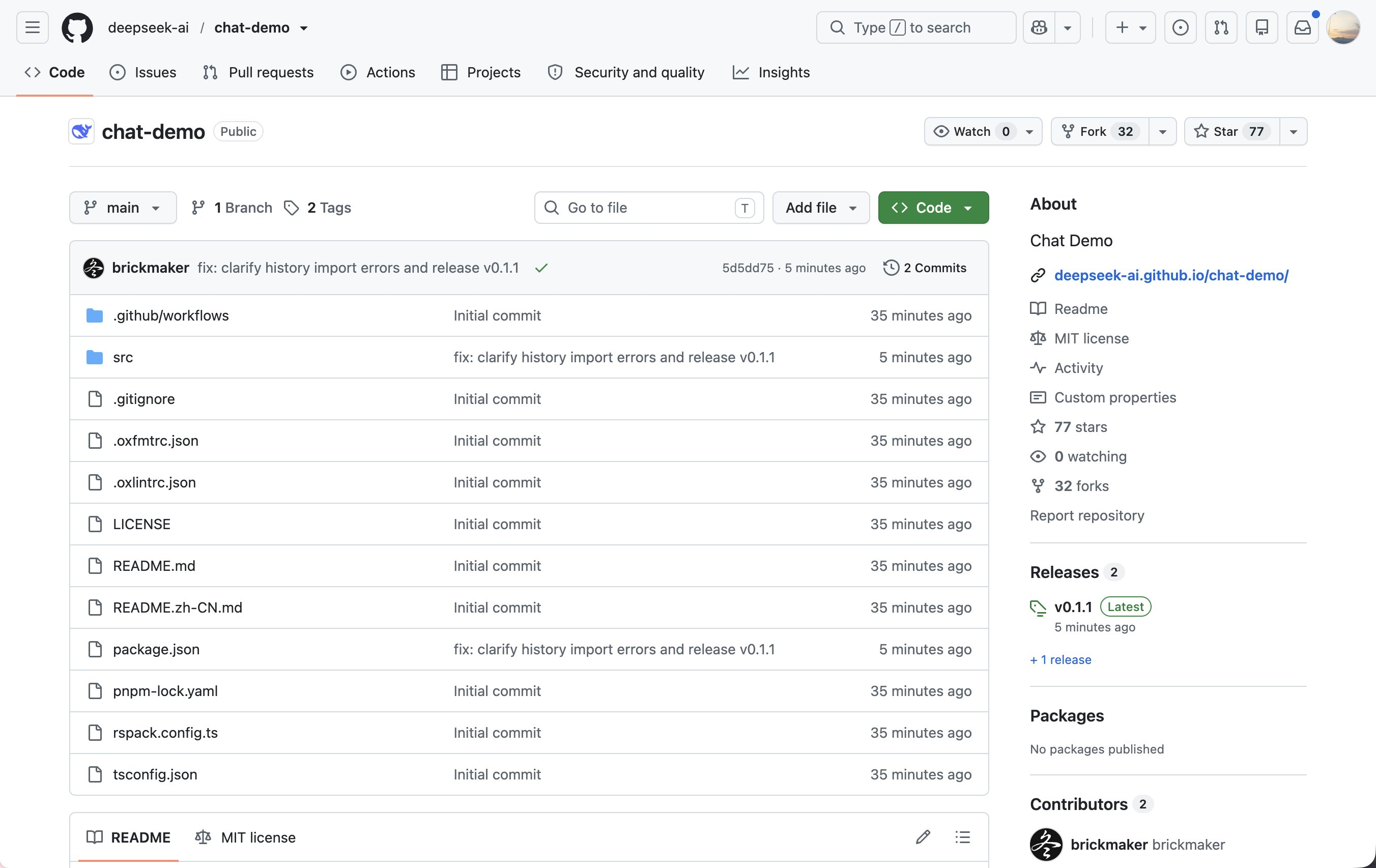
DeepSeek has released a lightweight, open-source chat demo to demonstrate the expanded APIs. The browser-based client connects directly to the API and supports importing conversation history exported from DeepSeek Chat.
The company says the API suite can reproduce the core functionality of its app, giving developers a reference implementation for building their own conversational products.
Tool Usage Adds Charges Beyond Tokens
The expanded capabilities introduce additional usage charges. Developers pay for relevant tool calls on top of model token consumption, so application costs will depend on both model usage and the tools invoked.
The release also includes a safety-check parameter for reviewing model inputs and outputs. DeepSeek instructs developers offering public-facing services to enable it and states that service providers remain responsible for applicable content review, model registration and AI-labeling obligations.
A Broader Foundation for AI Applications
The practical change is that more of the infrastructure surrounding a model is now available from the same provider. By combining inference, search, document processing and voice tools, DeepSeek aims to reduce integration work and make it easier for developers to build their own AI products.