ings
ings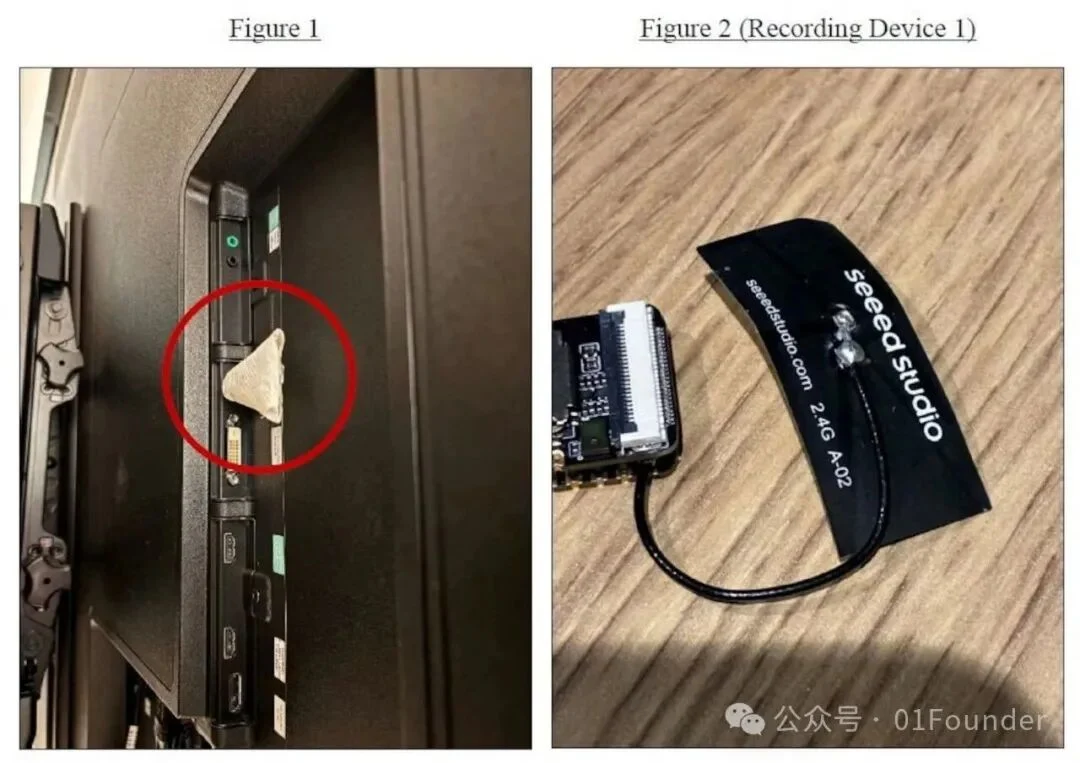
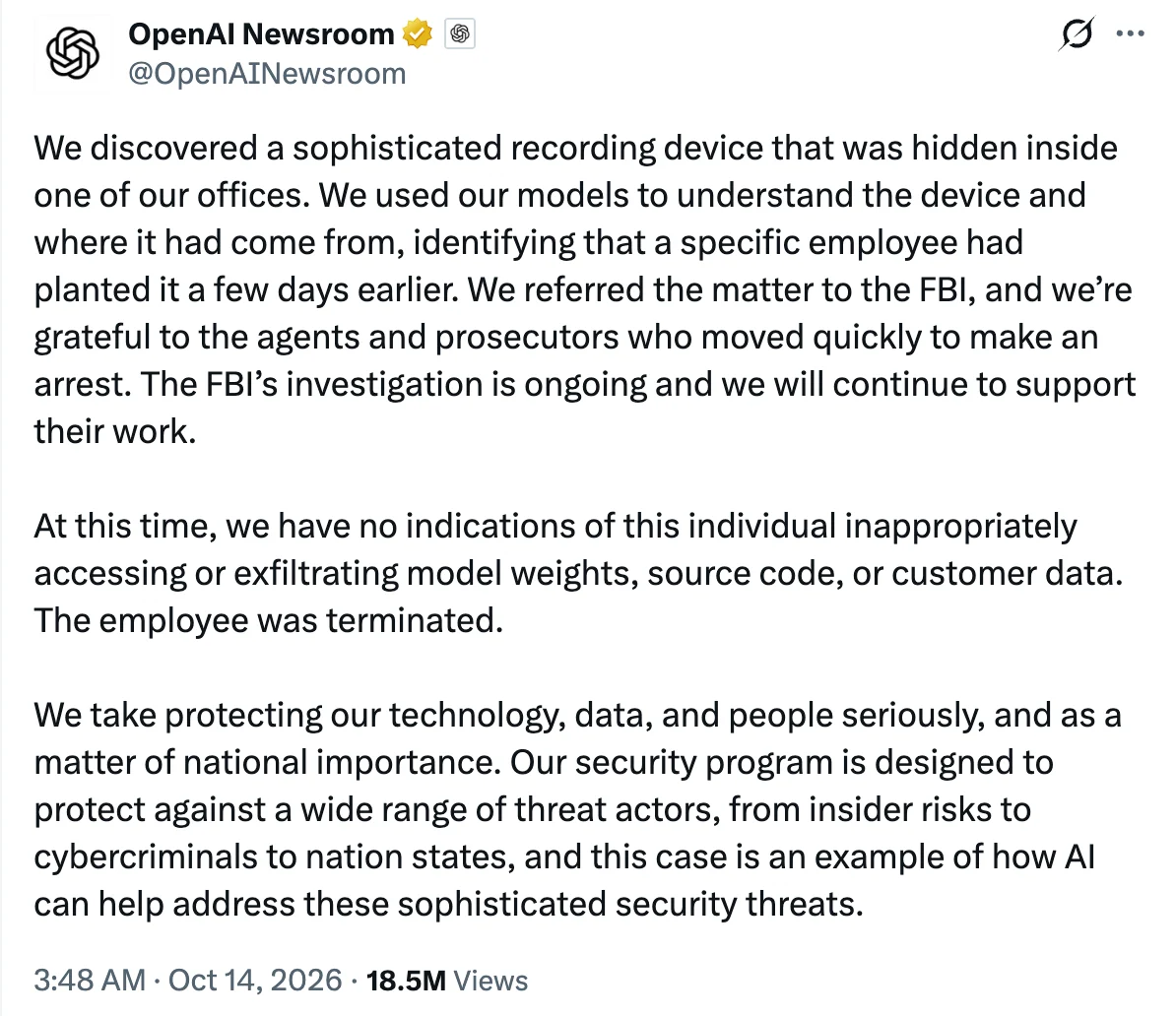
OpenAI said on October 13, 2026, that it had discovered a hidden recording device in one of its offices and used its own AI models to help investigate the device and its origins. The company said the investigation helped identify an employee suspected of installing it. OpenAI referred the matter to the FBI and terminated the employee.
In an October 13 announcement, the U.S. Department of Justice identified the defendant as Abdulrahman Alfozan, a 35-year-old Saudi national. He is accused of installing a concealed audio recorder in an executive conference room at OpenAI's San Francisco offices. Alfozan was arrested on October 9 and made his initial appearance in federal court on October 13. The allegations have not been established at trial, and he is presumed innocent unless proven guilty.
PART.01 A Recording Device Behind a Television
According to the Justice Department, OpenAI personnel discovered the device on September 30. It was plugged into a USB port on the back of a television and concealed in toilet paper. OpenAI determined that it had been installed on or around September 28 and that its stored contents were encrypted.
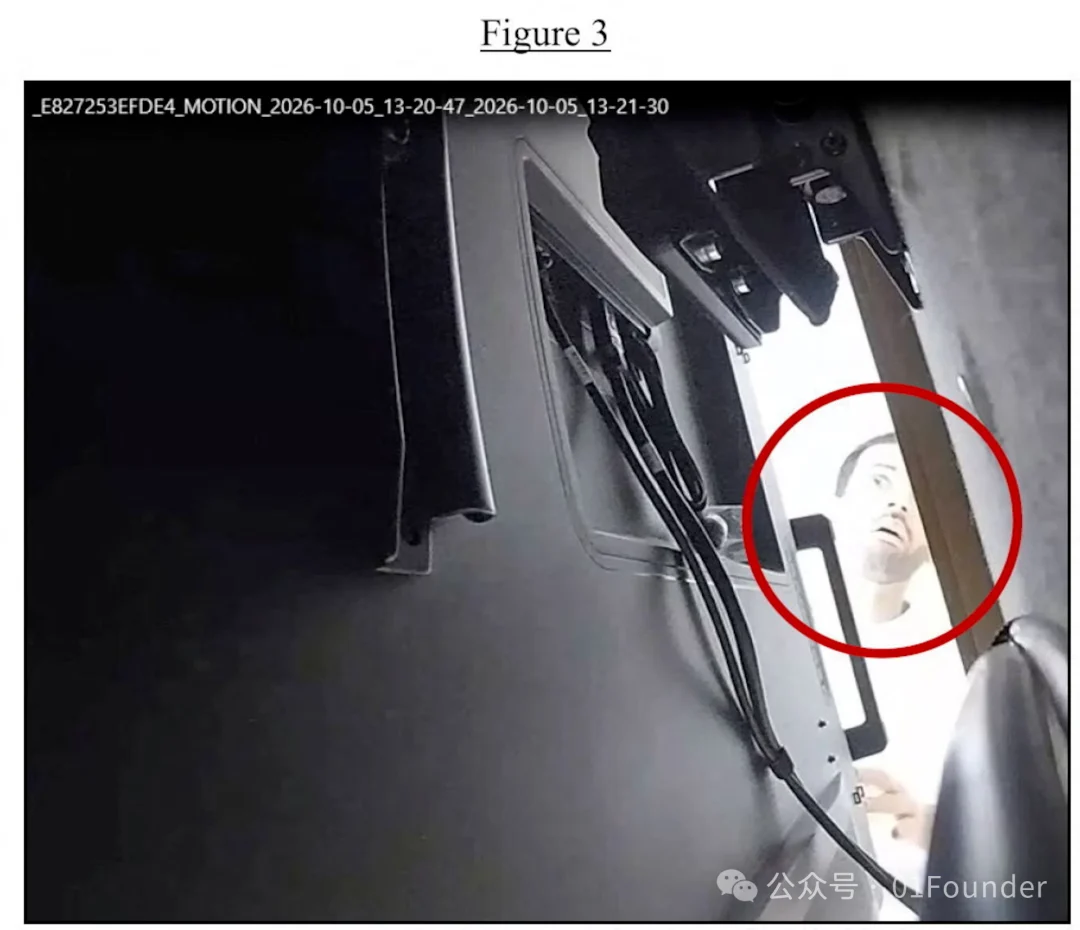
Prosecutors said the room was used for discussions involving confidential research, product plans, business opportunities, technical progress, strategic decisions, government engagements and commercial relationships. Alfozan was not authorized to access the room or participate in its meetings.
After discovering the device, OpenAI removed it for examination, closed the conference room and conducted additional security checks.
OpenAI told media outlets that its models assisted with analysis of a forensic image of the device's storage and changes in the underlying data. The company did not identify the specific model used.
WIRED reported that the hardware was a Seeed Studio XIAO ESP32-S3 Sense development board. The board uses an ESP32-S3 chip from Espressif Systems, supports Wi-Fi and Bluetooth connectivity, and measures approximately 21 by 17.5 millimeters.
The manufacturer's product listing describes a board with a digital microphone, a camera sensor and an external SD card slot, intended for embedded machine-learning applications such as voice and vision projects. The board is listed at about $14; this is the price of the development board, rather than the cost of a complete modified recording system.
OpenAI told TechCrunch that the device had been customized with audio-monitoring capabilities, encryption and data-transmission mechanisms intended to evade detection.
According to the Justice Department, a chatbot account associated with Alfozan's spouse submitted queries about continuous recording, live audio monitoring, customized Wi-Fi connectivity and SD card encryption. Some prompts included the recovered device's unique MAC address. Prosecutors said the account shared identifiers and attributes with Alfozan's own account.
The public disclosures reviewed for this report do not establish whether the device's camera was activated or whether recordings were transmitted outside the office over a wireless network.
PART.02 The Employee's Professional Background
Reuters reported, citing the FBI complaint, that Alfozan had been a U.S. lawful permanent resident since September 2020. According to the Justice Department, he joined OpenAI as an engineer in July 2025 and had worked there for more than a year before his arrest.
RAED Ventures' public biography describes him as an Engineering Lead at OpenAI working on AI agents and the data platform. That job title is attributed to the investment firm's profile; the Justice Department identifies his position as an engineer.
RAED's biography and appointment announcement state that Alfozan studied computer science and engineering at the Massachusetts Institute of Technology. They list earlier roles at Microsoft and SAP, followed by five years as a senior engineer at Meta, where he worked on machine learning and data platforms. He subsequently became a founding engineer at logistics technology startup Nash.
On February 8, 2025, RAED Ventures announced that Alfozan had joined the firm as a venture partner. The announcement said he would help identify investment opportunities and support the growth of startups.
A 2023 report by the Saudi Press Agency described Alfozan's involvement in a technology consulting center established by Saudi technology professionals in Silicon Valley. The report said he had received a scholarship from King Abdullah University of Science and Technology to pursue undergraduate studies in computer science and engineering at MIT after finishing high school.
According to that report, the center supported Saudi companies and institutions with services including machine learning, business data analytics, large-scale computing systems, technical proposal evaluation and recruitment for senior technical roles.
In September 2026, a Saudi interviewer published a video featuring Alfozan at OpenAI's San Francisco offices, where he discussed his work at the company. The video described him as OpenAI's only Saudi employee, a characterization that has not been independently confirmed.
PART.03 The Alleged Motive Remains Unclear
As of the Justice Department's October 13 announcement, Alfozan remained in federal custody. His next court appearance was scheduled for October 19, 2026, for a detention hearing.
If convicted on the announced charge, he faces a maximum penalty of five years in prison and a $250,000 fine, followed by three years of supervised release.
OpenAI said it had found no indication that Alfozan improperly accessed or exfiltrated model weights, source code or customer data.
The publicly released materials do not establish a motive, identify any intended recipient of recordings or determine whether other people were involved. They also do not establish that Alfozan acted on behalf of any government, company or competitor.
The disclosures so far describe the device's location, some of its technical characteristics, related chatbot queries and the defendant's legal proceedings. What the device recorded, whether any information left the office and the extent of any resulting exposure remain unresolved in the public record.
- U.S. Department of Justice ↗
- U.S. Attorney’s Office, Northern District of California ↗
- Associated Press — OpenAI statement and case details ↗
- WIRED — Device identification ↗
- Seeed Studio — XIAO ESP32-S3 Sense ↗
- TechCrunch — OpenAI statement on the device ↗
- RAED Ventures — Team biography ↗
- RAED Ventures — February 2025 appointment ↗
- Saudi Press Agency — February 2023 profile ↗
- Reuters, syndicated by HOT 96 ↗
- The San Francisco Standard — September interview reference ↗