 ings
Jensen Huang Resigns as Nvidia CEO; Colette Kress Named Interim Chief
Jensen Huang’s 33-year tenure ends as Nvidia names Colette Kress interim CEO and Harvey C. Jones board chair, opening a pivotal succession process.
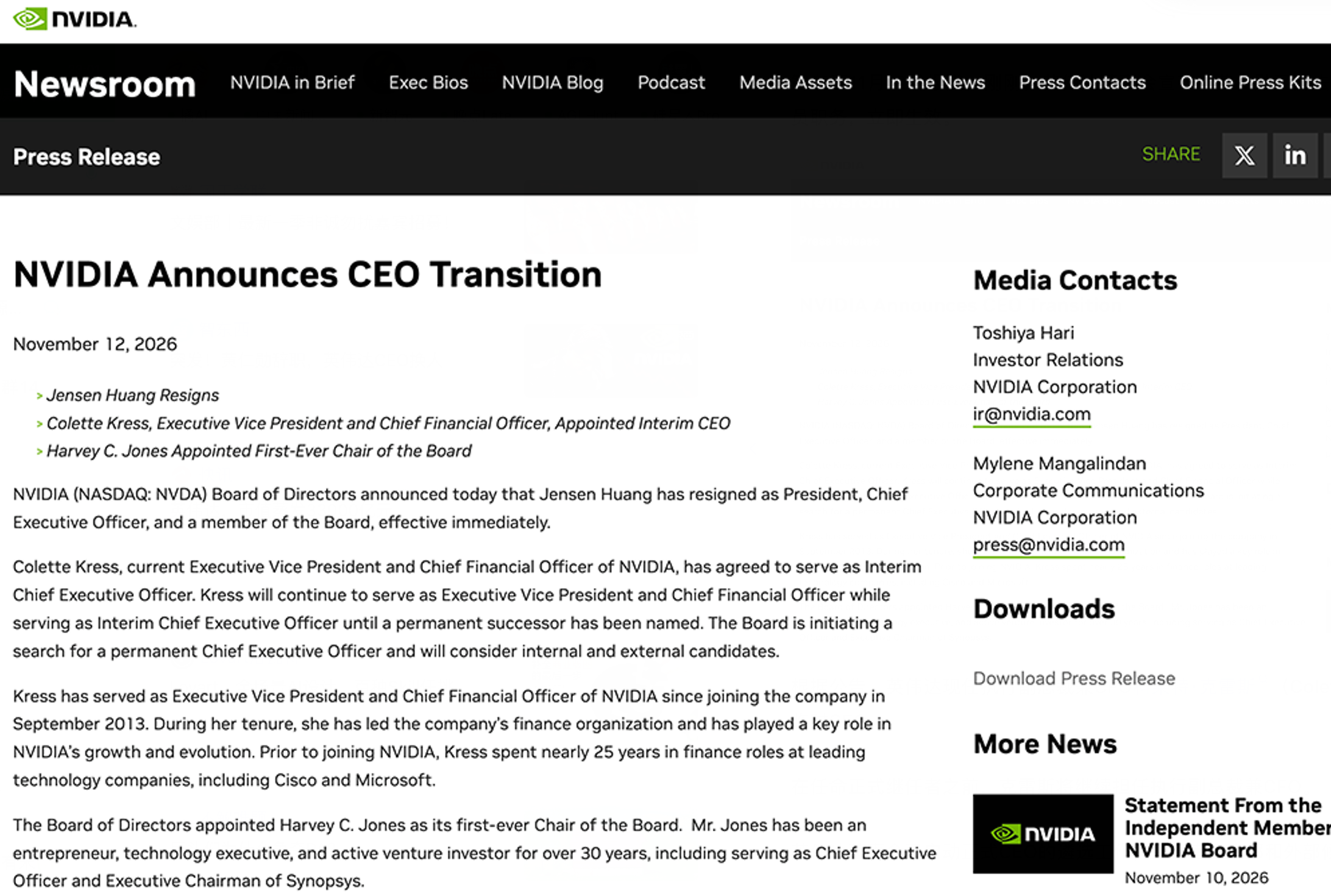
Jensen Huang has resigned as Nvidia’s president, chief executive officer and board member, effective immediately, ending a 33-year tenure at the company he co-founded and helped turn into a cornerstone of the global artificial intelligence industry.
Nvidia named Chief Financial Officer Colette Kress interim CEO and appointed Harvey C. Jones as its first board chair. The company will consider internal and external candidates for the permanent CEO role. Nvidia’s CEO transition announcement.
Nvidia’s CEO transition announcement dated November 12, 2026. Source: Nvidia Newsroom; screenshot supplied by the author.
Colette Kress Takes Over During a Critical Transition
Kress will continue serving as executive vice president and CFO while leading the company on an interim basis. She joined Nvidia in September 2013 and has overseen its finance organization throughout a period of extraordinary growth.
Before joining Nvidia, Kress spent nearly 25 years in finance roles at technology companies including Cisco and Microsoft. Jones, an entrepreneur and technology investor, previously served as CEO and executive chairman of Synopsys.
The appointments give Nvidia an experienced leadership team for the immediate transition. Kress now faces the task of maintaining operating discipline and customer confidence while the board determines who will lead the company over the longer term.
An Admission and Investigation Preceded the Departure
The leadership change follows a message published by Nvidia on November 8 in which Huang acknowledged being unfaithful to his wife and apologized to his family, colleagues, partners and shareholders. He accepted responsibility for his actions and pledged to cooperate with the board’s independent investigation. Huang’s message to employees.
In a separate statement, the board said it was investigating reports that Huang had been targeted by a foreign intelligence effort. The announcement of an investigation is not a finding that company information was compromised or that the allegations have been substantiated. Nvidia board statement.
His departure nevertheless turns the controversy into an immediate corporate challenge. Nvidia must manage a change at the top while responding to questions about executive conduct, oversight and the resilience of its leadership structure.
Shaun Maguire’s Response Highlights the Succession Debate
The debate over Huang’s future has also exposed tensions between demands for accountability and concerns about losing a central figure in the AI industry. A screenshot of a post by investor Shaun Maguire, displaying a November 9 date, captures that tension.
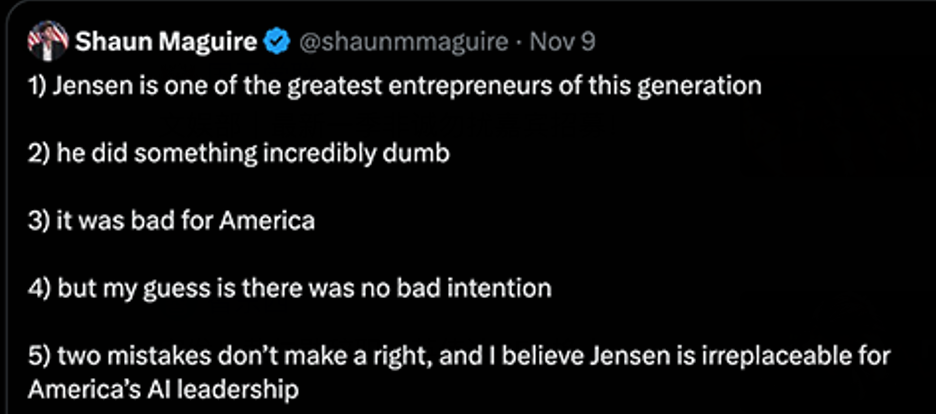
A screenshot of Shaun Maguire’s post, displaying a November 9 date. His comments express an opinion, not an investigative finding. Screenshot supplied by the author.
Maguire criticized Huang’s conduct and described it as harmful to the United States, while arguing that Huang remained essential to American AI leadership. He also suggested that Huang had not acted with bad intentions. That assessment was Maguire’s opinion, not a conclusion from the board’s investigation. Reporting on Maguire’s remarks.
The broader question for Nvidia is how to preserve the strategic advantages associated with its founder while ensuring that authority and accountability remain embedded in the company’s governance.
The Board’s Role Comes Into Focus
Nvidia’s 2026 proxy materials identified Stephen C. Neal as lead director and classified the serving directors other than Huang as independent. The filing also disclosed the expansion of the board from 10 to 11 members and Suzanne Nora Johnson’s appointment, effective July 13, 2026. Nvidia’s 2026 annual report and proxy.

The supplied board directory screenshot still lists Huang as president and CEO; it does not show the post-transition board roster. Source: Nvidia investor relations; capture date not supplied.
The supplied board directory screenshot shows 11 names and still identifies Huang as president and CEO. It provides background on the board’s composition, rather than a current roster following his resignation.
Jones’s appointment as chair creates a new point of responsibility for board leadership during the transition. The succession process will test the board’s ability to balance continuity, independent oversight and the demands of a rapidly evolving technology business.
From Graphics Chips to the Foundations of Modern AI
Huang founded Nvidia in 1993 with Chris Malachowsky and Curtis Priem. The business began with graphics technology and expanded into a computing platform whose influence reached far beyond gaming.
Nvidia introduced the GeForce 256 in 1999 and unveiled its CUDA architecture in 2006, extending GPU computing into science and research. In 2012, AlexNet demonstrated the power of GPU-accelerated deep learning, helping lay the foundations for the modern AI boom. Nvidia’s corporate timeline.
The rise of generative AI after ChatGPT’s launch in late 2022 sharply increased demand for the infrastructure Nvidia had spent years developing. Its processors, software ecosystem and systems expertise became central to the ambitions of AI developers and cloud providers.
Huang became the public face of that transformation. His product presentations and industry relationships tied his personal reputation closely to the company’s strategy, making the transition unusually consequential.
What Comes Next for Nvidia
Nvidia said its fiscal 2027 third-quarter results would be released on November 17 at approximately 1:20 p.m. Pacific Time, followed by an earnings call at 2 p.m. Nvidia’s CEO transition announcement.
The update will provide an opportunity to assess business performance and hear how the leadership team plans to manage the transition. Customers and partners will also look for clarity on product development, delivery commitments and operational continuity.
An internal successor could bring familiarity with Nvidia’s engineering culture and operating priorities. An external appointment could introduce a different management perspective, but would face a substantial learning curve. Neither possibility should be treated as the board’s preferred outcome before it announces a decision.
Huang’s departure does not erase the technology, talent or developer ecosystem built during his tenure. It does require Nvidia to demonstrate that those strengths can sustain its momentum under new leadership—and that the institution can carry forward what its founder helped create.