 ings
Grok Build Apps Left Company Secrets and Patient Records Exposed
Claroc estimates that 650 to 800 publicly accessible Grok Build apps contained private data. Exposed records included internal sales documents, employee performance information and patient medical details.
More than 35,000 applications built with Grok were accessible without a login, with hundreds estimated to contain private information, according to a November 10 report from security firm Claroc. The exposed material included internal sales documents from SpaceXSI and X, employee performance records from Tesla, and a patient's medical information.
Grok Build lets users create and publish applications by describing what they want in a chat. Claroc found that some users had published tools containing sensitive data with access settings that allowed anyone who obtained the address to open them. The affected organizations included Grok's own operator, SpaceXSI, the business formed from SpaceX and xAI. Sources: Claroc, Ars Technica
What the Exposed Apps Contained
Researchers tested 43,551 application addresses, of which 37,571 were still online. They could open 35,578 without signing in, representing 94.7% of the live apps in their sample.
Most were games, calculators or landing pages. After automated screening and manual sampling, Claroc estimated that approximately 650 to 800 contained private data. The findings do not mean that all 35,578 publicly accessible apps held sensitive information, or that the sample represents every Grok Build application.
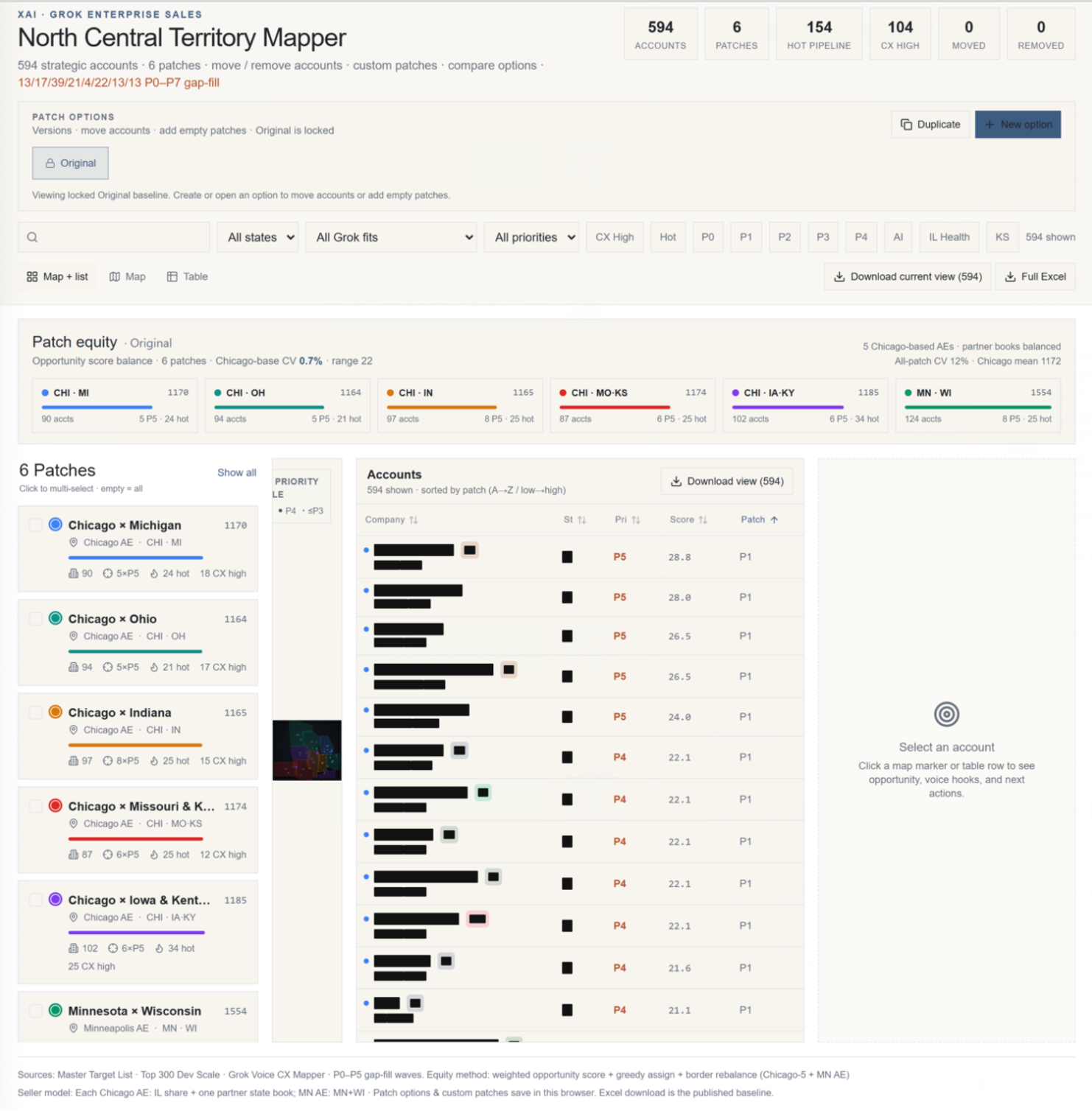
Among the exposed tools were 24 apps created by SpaceXSI and X employees. They contained onboarding documents, sales information, advertising proposals and customer campaign reports. One sales-territory dashboard covered 594 strategic customer accounts.
The exposed sales dashboard lists 594 accounts across six territories, with customer priorities and sales-opportunity indicators. Customer-identifying details are redacted.
The personal information found in other apps included an intensive-care patient's laboratory results, imaging information and ventilator status. A contractor's timesheet application contained 18 account passwords stored in plaintext inside a script that visitors' browsers could download.
Ars Technica also reported that a Tesla service-center scorecard identified 22 technicians and listed their productivity and bonus status. The disclosure concerned those records, rather than Tesla's entire payroll. Sources: Claroc, Ars Technica
How Researchers Found the App Links
Claroc found the applications through domain records. Each published Grok Build app receives its own address under grok.me, typically using a randomly generated name. Those names can appear in passive DNS databases, which collect records of domain lookups.
That gave researchers a way to find application addresses without guessing them or receiving links from their creators. Where access was open to anyone with the link, discovering the address was enough to view the page.
An Authorization Flaw in a Test App
The researchers also tested the code Grok generated for a customer-management application intended for a four-person sales team. They used fictional data and published the app themselves.
Grok added Google and X sign-in options, but the generated code enrolled each person who signed in as a team member before checking whether they belonged to the team. An uninvited Google account could therefore access all customer records, edit one and delete another.
Claroc performed those actions only in its own test application. It did not establish that the other exposed apps allowed outsiders to modify or delete records. Source: Claroc
SpaceXSI's Response and App Removals
SpaceXSI said apps remain private until their creators choose to share them and that publishing requires several steps. It also said employee accounts default to owner-only access, so staff must change that setting to make an app publicly accessible.
Claroc reported a different experience with its paid test account: the publishing interface had already selected access for anyone holding the link.
The dispute concerns the access setting presented during publication. Both sides agree that an application does not become public simply because a user creates it. The available findings also do not establish that all account types use the same defaults.
Claroc confirmed that Grok's restrictive settings worked when applied. Switching one test app to owner-only access blocked an outside visitor from both its page and data endpoint. Unpublishing another took it offline within seconds.
The firm first reported the exposure to SpaceXSI on November 8 and submitted details of additional employee apps on November 9. By the time Ars Technica published its report on November 10, all 24 identified apps created by SpaceXSI and X staff had been removed.
Other users' exposed applications remained accessible at that time. Claroc had begun notifying affected organizations directly, while the platform had not provided a clear answer to Ars Technica about whether it would contact other affected customers. Sources: Claroc, Ars Technica