ings
ings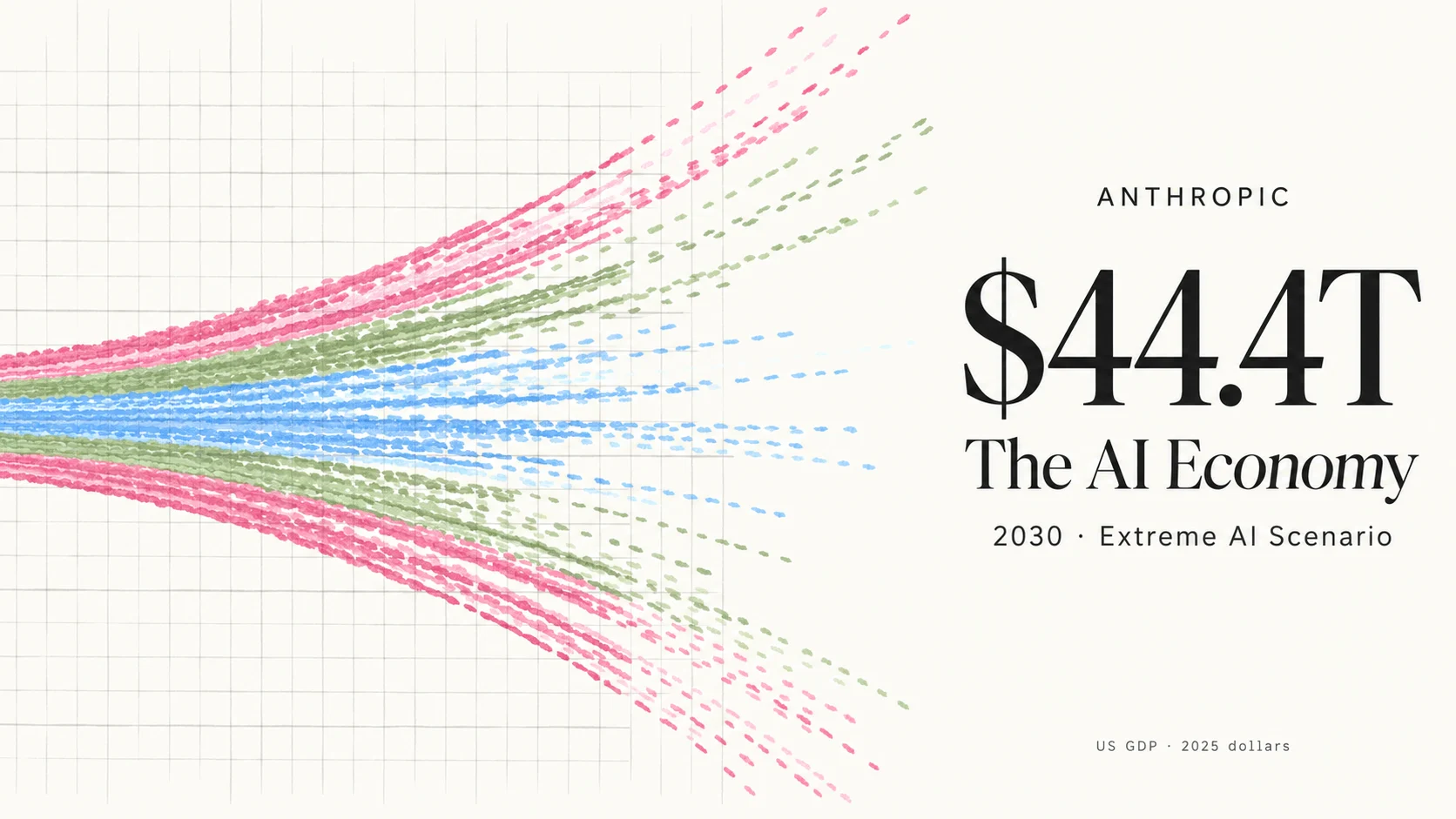
On October 17, 2026, Anthropic co-founder Jack Clark addressed AI’s potential economic impact at the Per Jacobsson Foundation Lecture in Bangkok. The event focused on scientific discovery, autonomous businesses and the possibility of AI helping develop its own successors. Source: IMF
Anthropic’s economic research puts a striking number on one possible future: US GDP reaching $44.4 trillion in 2030. That outcome depends on specific assumptions about AI capabilities and adoption, rather than representing a firm forecast.
What Would a $44.4 Trillion Economy Require?
Measured in 2025 dollars, Anthropic’s modest scenario puts 2030 GDP at $34.1 trillion, 1.6% above its no-AI baseline. Its substantial scenario reaches $36.3 trillion, an 8.3% increase. The extreme scenario reaches $44.4 trillion, or 32.4% above baseline. Source: Anthropic
The extreme case depends on rapid adoption of highly productive AI across knowledge work, potentially enabled by recursive self-improvement: AI helping improve subsequent AI systems.
The report’s separate 15.4% figure describes annual GDP growth in 2030 under that scenario—not the cumulative uplift above baseline. Source: Technical report
Higher Output, Uneven Benefits
The same extreme scenario puts knowledge workers’ wages 11.5% below the no-AI baseline and overall unemployment at 11.9%. These are simulated outcomes, not observed changes. Source: Technical report
Productivity and personal income would not necessarily rise together. Strong headline growth could also conceal widening differences between occupations.
Will Ordinary People Share in AI’s Gains?
Turning better models into economic growth requires changes inside businesses, from adopting new tools to reorganizing workflows and helping workers move into new roles. Anthropic acknowledges that its model simplifies reality and that actual outcomes could differ substantially. Source: Model overview
The $44.4 trillion scenario captures the wealth AI could create. But businesses doing more with fewer people would not automatically mean higher wages or new jobs for displaced workers.
AI could make America richer. Whether it makes life better for ordinary people is the real test.