 ings
OpenAI’s latest model cuts API prices and improves computer use, but its efficiency gains have done little to satisfy users waiting for a new flagship.
OpenAI has released GPT-6.1 Terra with a familiar promise: more capability for less money. The new model targets everyday computer work, with improvements in coding, visual understanding, and reliability. It is available through the API and to Plus, Pro, Enterprise, and Edu subscribers in ChatGPT Work and Codex. OpenAI’s announcement
The reception exposes a gap between what OpenAI is selling and what some users want. Developers have reasons to welcome a cheaper model. Subscribers hoping for a challenger to Claude Opus 5.5 have a different question: where is the next flagship?
On Reddit’s r/codex, one launch thread captured the frustration in its title:
“This straight up feels like an advertisement for claude.”
The discussion reflects a recurring tension in AI releases: an improvement in cost efficiency can still feel disappointing when expectations are set around raw performance.
01 — Better Economics, Familiar Hierarchy
GPT-6.1 Terra’s standard API pricing is $1 per million input tokens, $0.05 per million cached input tokens, and $5 per million output tokens. Those rates put it at half Sol’s standard input and output prices. OpenAI pricing
Compared with GPT-5.6 Terra’s $2 input and $12 output rates, the reductions are 50% and roughly 58%, respectively. Artificial Analysis also measured a sharp drop in the cost of completing its intelligence evaluation: $0.40 per task, down from $1.40, a reduction of more than 70%. Artificial Analysis
The capability gains are real. In OpenAI’s testing, Terra’s Terminal-Bench 4.0 score rose from 21.5% to 50.3%. On Agents’ Last Exam, it scored 60.0%, close to Opus 5.5’s 63.2%, at roughly one-ninth the cost per task at maximum reasoning effort. OpenAI benchmarks
Broader intelligence rankings are less dramatic. Artificial Analysis places Terra at 48, four points behind Sol. Opus 5.5 scores 58 at maximum effort with its default fallback configuration. Terra evaluation, Opus 5.5 evaluation
Still, calling Terra merely average misses its strongest result. Artificial Analysis describes its low and medium reasoning settings as:
“Pareto-optimal for cost efficiency.”
At those settings, Terra sits on the evaluator’s cost-performance frontier. Its higher reasoning settings do not. That makes the choice of reasoning effort central to its value proposition. Artificial Analysis findings
For developers running thousands of tasks, those economics matter. For users measuring every release against the strongest model available, they are less persuasive.
02 — Beyond the Benchmarks
OpenAI’s official documentation describes Terra as:
“A fast, efficient model for visual reasoning, precise computer use, and clear, natural writing.”
Its suggested uses include interpreting technical drawings, matching product photos to catalog entries, working across application screens, and drafting or revising text. The emphasis is on practical work that combines reading, judgment, and action. GPT-6.1 Terra documentation
Reliability is another notable improvement. On OpenAI’s internal factuality evaluation, Terra’s error rate at low reasoning fell from 53.6% to 16.7%. At maximum effort, it dropped to 4.3%. OpenAI factuality results
These improvements give Terra a plausible role in workflows where mistakes, retries, and unnecessary reasoning all add cost. A model does not have to lead every benchmark to be useful in production.
OpenAI is also explicit about where Terra stops. Its announcement states:
“For the most complex coding tasks, GPT-6.1 Sol and GPT-6 Astra remain the better choice.”
That distinction helps explain the reception. Terra improves the economics of getting work done, while leaving OpenAI’s flagship hierarchy largely intact. OpenAI’s model guidance
03 — Where Does Terra Fit?
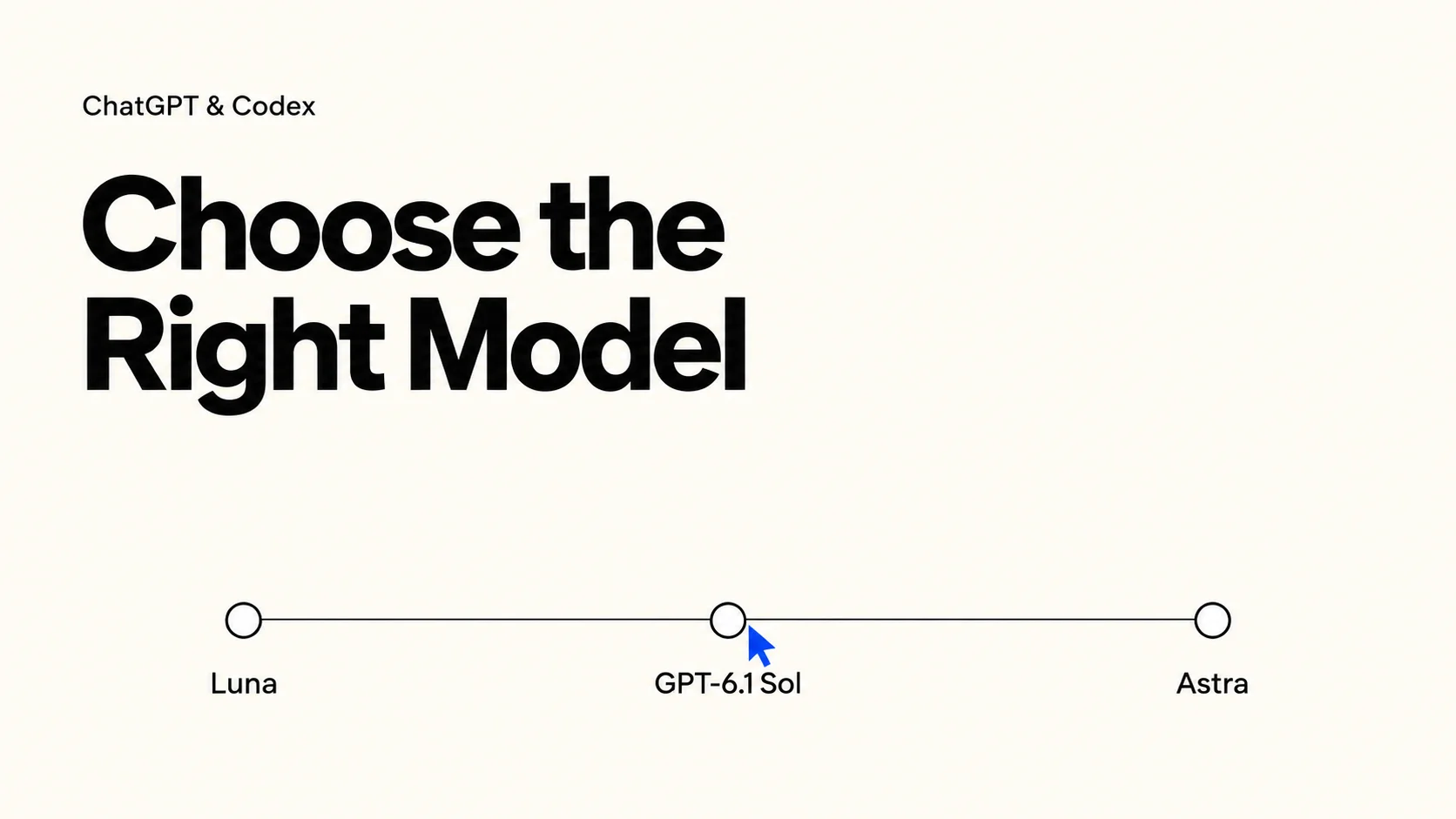
Terra faces pressure from both sides of OpenAI’s lineup. Luna serves focused, high-volume tasks at the lowest cost, while Sol and Astra target more demanding work. OpenAI’s own model guide places Terra between those options, emphasizing visual reasoning, computer use, and writing. OpenAI model guide
The difficulty is that those categories overlap. A newer, smaller model can outperform an older, larger one on particular tasks, making a simple good-better-best hierarchy increasingly unreliable.
Responding on Hacker News, OpenAI researcher Ted Sanders said Terra could be better than Sol and Astra at technical communication, comparable in vision and computer use, and faster—while remaining weaker on most other tasks. For API developers, he described it as a useful middle ground between Sol’s cost and Luna’s capabilities. Sanders’ explanation
His assessment for subscribers was more restrained:
“For subscribers, it’s not a bombshell release.”
Sanders pointed instead to practical benefits: stretching usage allowances, clearer communication, and faster computer use. Hacker News comment
That is a reasonable case for Terra. It is also a smaller promise than the one many users were waiting for.
Developers can judge the release by the work it completes per dollar. Users waiting for OpenAI’s next flagship will judge it by whether it can beat their current favorite. Terra gives the first group something useful to evaluate. The second is still waiting.