 ings
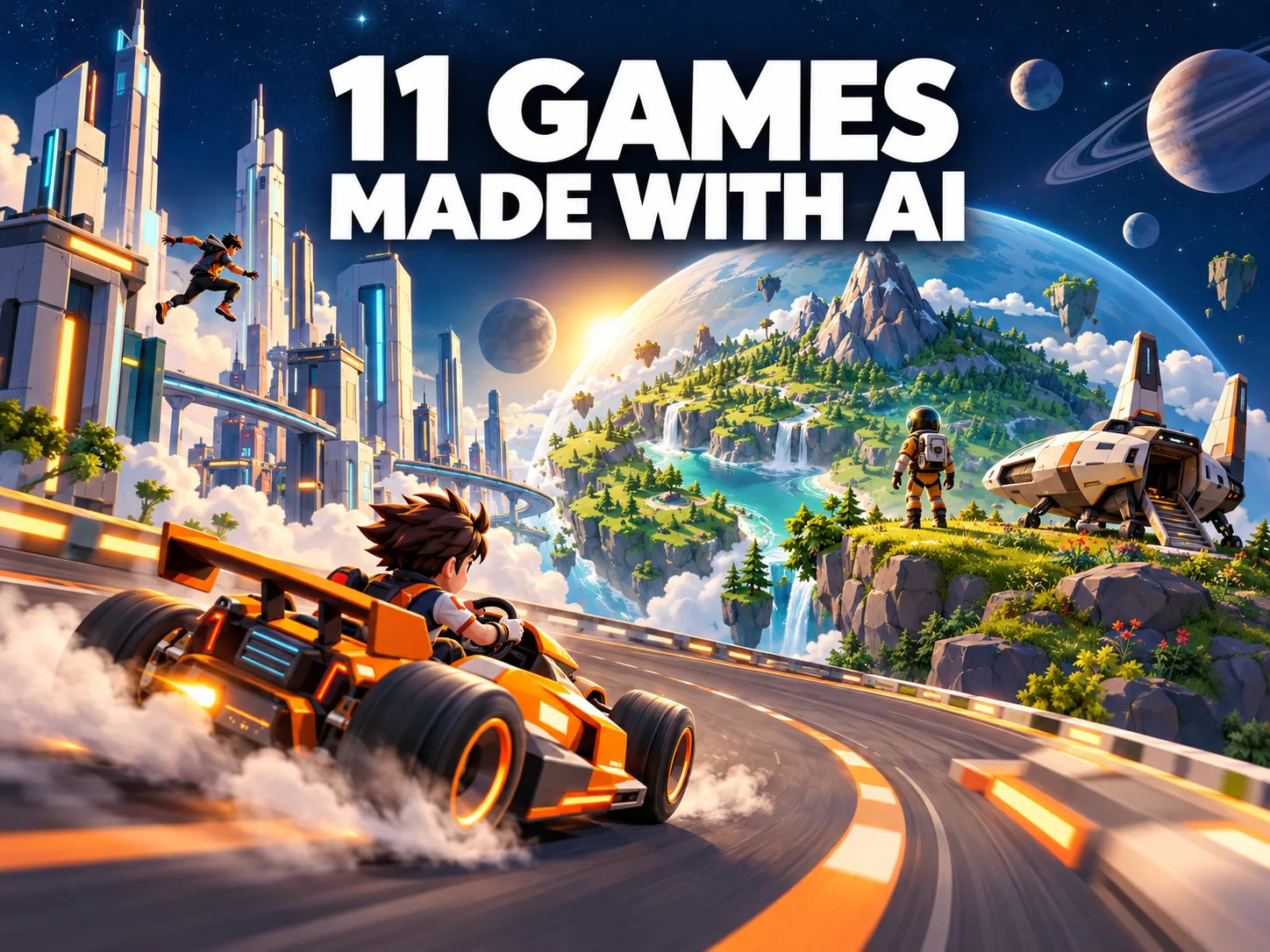
Explore a planet inspired by The Little Prince. Swing between skyscrapers. Race a kart around a tropical circuit. Land a spaceship on a distant world, then step outside.
These are some of the experiences creators are exploring through games made with AI.
The 11 projects below span sci-fi shooters, racing games, action games, and 3D adventures. They illustrate different approaches to AI-assisted game development, from generating code for browser games to combining existing tools, assets, and game systems.
Some have playable browser versions and public repositories. Others are early showcases. The role of AI varies between projects, and a compelling demo does not necessarily represent a finished game—but there is already plenty to explore.
1. A Sci-Fi Shooter with Squad Combat
Move through streets and buildings in powered armor, advance alongside a squad, and fight for control of marked objectives.
In the creator’s description, this AI-assisted shooter was developed using Claude and Three.js. The showcase combines a futuristic environment with familiar combat mechanics: moving between cover, engaging enemy soldiers, and pushing toward capture points.
What makes it interesting is the way these elements work together. The player has a squad to follow, opponents to engage, and destinations that give the action a clear direction.
View Belbizaz’s sci-fi shooter showcase
2. A Call of Duty, Skateboarding, and Minecraft Mashup
Chasm’s project combines experiences that normally belong to separate games.
Players can use weapons from Call of Duty: Modern Warfare 2, ride a skateboard through the environment, and explore a Minecraft world. Moving between those activities gives the project its unusual identity.
The public repository builds on existing community development work and requires the relevant original game files for its features. It offers a different example of AI game development: using AI assistance to extend and connect established systems.
The result is an experimental playground for shooting, skating, and block-world exploration.
View Chasm’s game showcase · Explore the GitHub repository
3. The Little Prince as an Explorable 3D Adventure
This project transforms the planets of The Little Prince into places players can explore.
The showcase follows the character around his small world, approaching his rose and visiting locations associated with other characters, including the king. Familiar story elements become part of a navigable 3D environment.
Its appeal comes from the connection between reading and exploration. A planet that once existed on a page becomes a place where players can move, look around, and approach something that caught their attention.
It is an example of how AI-assisted game projects can give a familiar story a new interactive form.
View The Little Prince game showcase
4. Spiderbench: Web-Swinging Through a Browser-Based City
Leap from a rooftop, fire a web, swing over a street, and run along a wall toward the next building.
Spiderbench explores Spider-Man-style movement in a browser-based 3D city. Vehicles and pedestrians add activity below, while the buildings provide a landscape for traversal.
The attraction is the movement: falling from a roof, catching a swing, and climbing back above the street. Changes in height and momentum make crossing the city an activity of its own.
The project has a public repository for readers interested in exploring its implementation.
View the Spiderbench showcase · Explore Spiderbench on GitHub
5. INKWAVE: An Ink-Based Territory Game
INKWAVE draws on the territory-control mechanics of Splatoon.
Players spray ink across the ground, claim space for their team, and move quickly through areas covered in their own color. Combat and movement both affect control of the arena.
Each exchange changes the environment. A useful route can become enemy territory, while a newly painted area creates an opportunity to advance.
The bright colors make the objective easy to understand: cover more of the map while responding to an opponent who is trying to do the same.
View the INKWAVE game showcase
6. The Minecraft Test: A Block World with Richer Lighting
The Minecraft Test explores the visual possibilities of a Minecraft-style browser game.
Mountains, forests, and block-based terrain provide a familiar setting. Water reflections, sunlight, and changes between day and night give that environment different moods.
The showcase focuses on how rendering choices affect a simple visual style. Reflections make water feel connected to its surroundings, while light and shadow add depth to forests and landscapes.
Among these AI game examples, it emphasizes the pleasure of exploring a place and watching its atmosphere change.
View The Minecraft Test showcase
7. An Old-School RPG Prototype
The project shared by Stefan brings together several foundations of a role-playing game: character creation, a town to explore, and combat.
Rather than concentrating on a single action, it attempts to connect multiple parts of an adventure. Players establish a character, enter a setting, and begin interacting with the world.
The project is presented as an early version, with AI involved in its development.
It offers a look at the broader scope of AI-assisted RPG development, where environments, characters, interfaces, and gameplay need to work together to support a longer experience.
8. Sky Reach: Spaceflight and Planetary Exploration
A planet appears in the distance. You fly toward it, pass through its atmosphere, land, and leave the cockpit to explore on foot.
Sky Reach attempts a space exploration experience in the spirit of No Man’s Sky.
The most compelling part is the shift in scale. A distant object becomes a landscape, and a destination seen from space becomes the ground beneath the player’s feet.
Combining flight with surface exploration gives the journey a clear payoff: arriving somewhere that looked unreachable only moments earlier.
View the Sky Reach space exploration showcase
9. Turbo Kart Rally: A Three.js Racing Game
Turbo Kart Rally is a browser-based arcade racer inspired by Mario Kart.
Players race around a circuit, drift through corners, release boosts, and collect items to help themselves or disrupt opponents.
According to its project documentation, the game uses Three.js, with models, textures, and audio generated through code. The repository also includes the creator’s initial prompt and describes how AI agents divided the development work.
With a browser demo and public source code, it is one of the more accessible projects in this collection for readers who want to move from watching a showcase to trying the game.
View the Turbo Kart Rally showcase · Play Turbo Kart Rally · Explore the source code
10. An Underwater Shipwreck Adventure
This project sends players into a submerged shipwreck to search for the ancient Antikythera mechanism.
The setting provides a compact adventure: enter an unfamiliar underwater environment, investigate the wreck, and locate the object hidden inside.
According to the creator’s description, the visuals and sound are generated by AI-written code, making procedural content part of the project’s design.
Underwater lighting, audio, and a specific search objective give this example a quieter atmosphere than the shooters and racing games elsewhere in the collection.
View the underwater adventure showcase
11. Voxel Musou: A Browser Action Game with Crowd Combat
Voxel Musou places a playable warrior on a battlefield filled with block-shaped soldiers.
Players chain attacks, dodge, and unleash special abilities while fighting through large groups of enemies. Its voxel models give the battlefield a toy-like appearance, while impact effects and enemy reactions support the action.
The public project has expanded beyond its initial showcase to include multiple playable characters, story chapters, and challenge modes.
Built with Three.js, it provides another example of a 3D browser game with public code and an online version to explore.
View the Voxel Musou showcase · Play Voxel Musou · Explore the source code
Together, these projects show the variety of ideas taking shape through AI-assisted game development.
Some focus on a single satisfying action, such as swinging between buildings or drifting around a corner. Others build explorable worlds, combine existing games, or connect several systems into an adventure.
Their scope and polish vary, but each turns an idea into something interactive. The projects with public code also give other creators a starting point for understanding, experimenting, and building further.
- Belbizaz — Sci-Fi Shooter Showcase ↗
- Chasm — Game Mashup Showcase ↗
- Saccc_c — The Little Prince Game ↗
- Xikhar — Spiderbench ↗
- Jayden Davis — INKWAVE ↗
- Noah Wachnik — The Minecraft Test ↗
- Stefan — RPG Prototype ↗
- Rubzem — Sky Reach ↗
- BridgeMind — Turbo Kart Rally ↗
- Edwin Arbus — Underwater Adventure ↗
- BubuStd — Voxel Musou ↗
- Chasm — Game Mashup Repository ↗
- Spiderbench — GitHub Repository ↗
- Turbo Kart Rally — GitHub Repository ↗
- Voxel Musou — GitHub Repository ↗