ings
ings
Consumer AI has a growing audience. Its paying audience is much smaller—and a relatively small group of intensive users accounts for a disproportionate share of spending.
That is one of the most revealing findings in a16z’s seventh AI apps report, published on October 5, 2026. Alongside rankings based on web traffic and mobile monthly active users, the report introduces consumer spending data to examine a different question: which products are people actually willing to pay for?
The results suggest that consumer AI is developing along several paths. ChatGPT and Claude serve different mixes of paying users. Subscriptions depend heavily on a narrow segment of customers. And personal agents could expand the market by taking on recurring tasks and participating in transactions.
The spending figures primarily come from YipitData’s sample of U.S. consumers. They offer a view of consumer behavior, rather than a complete picture of global demand or company revenue.
01 | AI Adoption Is Broad. Paid Adoption Is Still Limited.
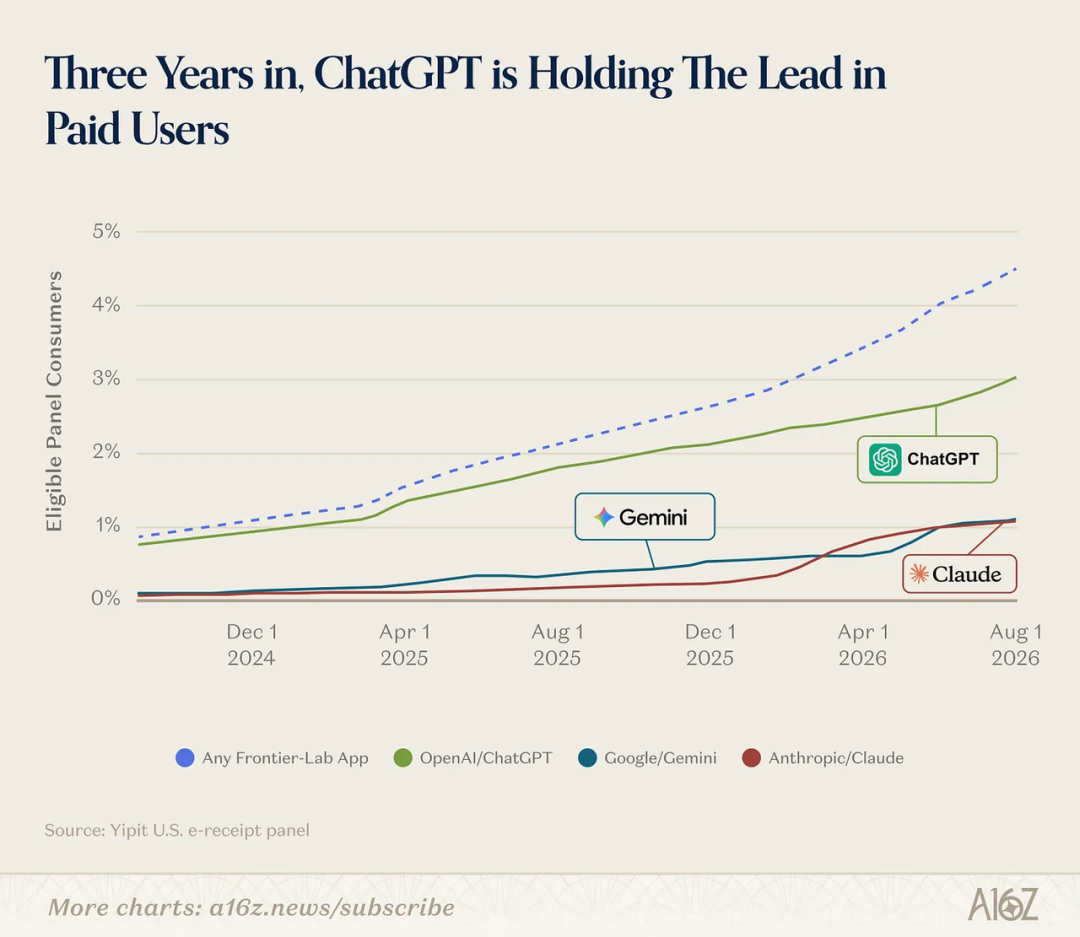
In Pew Research Center’s February 2026 survey, about half of U.S. adults said they used AI chatbots, and 24% used them daily. Separately, in August 2026, 4.5% of eligible consumers in YipitData’s U.S. e-receipt panel had an active paid personal subscription to at least one of ChatGPT, Gemini, or Claude, according to a16z. The survey and spending panel measure different populations and behaviors; these figures are not a direct conversion rate.
That share more than doubled from 2.1% a year earlier. The growth is meaningful, but it starts from a small base.
Within the paying audience, a16z’s spending analysis shows a high concentration. The top 10% of spenders account for roughly half of observed consumer AI spending; the top 1% alone contribute 19.5%. The lower-spending half of paying users account for 16.6%.
Median monthly spending among paying users is $25. The top 1% spend an average of $903 a month, and their spending increased by 80% over the 18 months to August 2026. Typical paying users’ spending barely changed over the same period.
For AI companies, this creates two distinct growth challenges: persuading more free users to pay, and giving existing heavy users reasons to spend more. Success with one group does not automatically translate into success with the other.
02 | ChatGPT and Claude Are Building Different Paying Audiences
ChatGPT retains a substantial lead in reach. a16z’s August traffic comparison puts its web visits at roughly twice Gemini’s and six times Claude’s. On mobile, its monthly active user base is about 2.5 times Gemini’s and 14 times Claude’s. Its U.S. individual paid subscriber base in YipitData’s panel is approximately three times that of either competitor.
Premium subscriptions tell a different story. In a16z’s analysis, 7.3% of Claude’s consumer payers subscribe to Max, which starts at $100 a month. The corresponding shares for higher-priced plans at Gemini and ChatGPT are 1.3% and 1.1%, respectively.
The plans are not directly interchangeable, but the gap suggests that Claude’s paying audience is more concentrated among intensive users. For these customers, a subscription is a work expense whose value can be measured in time saved and output delivered.
That fits Anthropic’s emphasis on products such as Claude Code, Cowork, and Claude Design. ChatGPT, meanwhile, serves a broader range of needs, from everyday questions and image generation to coding, analysis, and presentations.
The overlap is also less extensive than the competitive narrative might suggest. According to the report, only about 8% of U.S. ChatGPT subscribers also pay for Claude. That is a one-directional measure, but it shows that most paying ChatGPT users do not subscribe to both.
These differences matter commercially. A product embedded in professional workflows can build around premium subscriptions. A mass-market assistant must also find ways to serve frequent users who will not pay a monthly fee. The two approaches may lead to increasingly different revenue models.
03 | The Next Growth Challenge Is Finding Recurring Consumer Tasks
The concentration of spending points to a broader issue: intensive AI usage still has a strong connection to coding, data analysis, and technical automation. These activities generate a steady stream of tasks and make the value of AI relatively easy to measure.
a16z cites observations from AssistantBenchmark’s David Pawlan across seven early-user group chats involving 1,502 people. Coding and technical automation were the most frequently discussed task domain. These early communities should not be treated as a representative sample of mainstream consumers.
For mainstream consumers, many useful AI tasks are occasional. Planning a vacation or comparing flights can save time, but neither necessarily creates a daily habit. Greater model capability does not automatically give people more reasons to open an AI app.
Personal agents could address this by retaining context and identifying useful actions over time. With permission, an agent could connect travel plans with calendar entries and reservations, flag unfinished arrangements, or prepare a response to an email using the history of the conversation.
This would reduce the effort required to use AI. People would not need to restate the background or formulate a new prompt for every small task. Value could accumulate through routine assistance across the day.
Whether personal agents can deliver that experience reliably remains an open question. But it gives consumer AI a plausible route toward more frequent use beyond technical work.
04 | Transactions Could Expand AI’s Revenue Options
Today’s consumer AI business models remain heavily subscription-based. Among the 44 AI-native products in a16z’s web rankings, 84% offer paid subscriptions and 64% charge through credits or usage. Only 14% use advertising, while 2% earn revenue through transactions or platform fees. The categories overlap.
There is a practical reason for this structure. Frequent AI usage creates ongoing inference costs. Subscriptions and usage charges help companies recover those costs directly, rather than waiting for another revenue stream to mature.
Personal agents could create more opportunities for transaction-based revenue. An agent that helps someone book a hotel or buy a product is contributing to a purchase. That could support merchant commissions, referral fees, or transaction revenue alongside subscriptions.
a16z reports that both Muse and Instinct have described plans to earn transaction fees, though neither was doing so at the time of the report. That distinction matters: transaction-based monetization remains a proposed model rather than a demonstrated revenue stream.
Founder-reported figures cited by a16z offer another signal. Instinct founder Noah Shinn said 40% of users connected a personal credit card within three weeks. Among those users, once they made a purchase, monthly transaction volume averaged about $1,300. These figures are company claims reported by a16z, not independently audited results.
These are early-adopter figures, and transaction volume is not revenue. They do, however, suggest that some users are willing to bring agents into real purchasing decisions. The commercial test is whether those transactions can generate enough revenue to support the cost of serving a broader audience.
05 | Service Access Could Become a Competitive Advantage
A transaction-based model depends on more than a capable assistant. To complete purchases and bookings, agents need access to merchants, payment systems, inventory, and reliable execution interfaces.
a16z’s analysis of agent-driven commerce illustrates how differently platforms may respond. Amazon restricted Muse’s access, while Shopify and Instacart welcomed integrations. The consumer apps report also lists OpenTable, Expedia, and Ticketmaster among companies with official integrations. Shopify’s own documentation confirms that eligible merchants can offer direct checkout on Meta surfaces, including Muse where available.
For a merchant seeking additional orders, an agent can be a new source of customers. For a platform that already owns the customer relationship, it can change how products are discovered and how transactions are directed. Those incentives will shape which services agents can access and on what terms.
Long-term context provides another potential advantage. An agent that understands a user’s preferences, routines, and past decisions can become more useful over time. Switching products may involve transferring that information or rebuilding it elsewhere.
Agent-to-agent collaboration could eventually add a network dimension. With permission, two agents might coordinate calendars and arrange a meeting. But integrations and stored context do not, by themselves, establish network effects. a16z describes meaningful multiplayer appeal as largely absent from today’s leading consumer AI products. That supports treating network effects as a potential source of advantage rather than an established feature of the category.
For now, consumer AI’s paying market remains concentrated. Personal agents offer a possible route to a broader one—provided they can turn context into useful action, complete tasks reliably, and generate revenue that supports the service. Those capabilities will help determine how far the market can grow beyond today’s power users.