
 ings
ings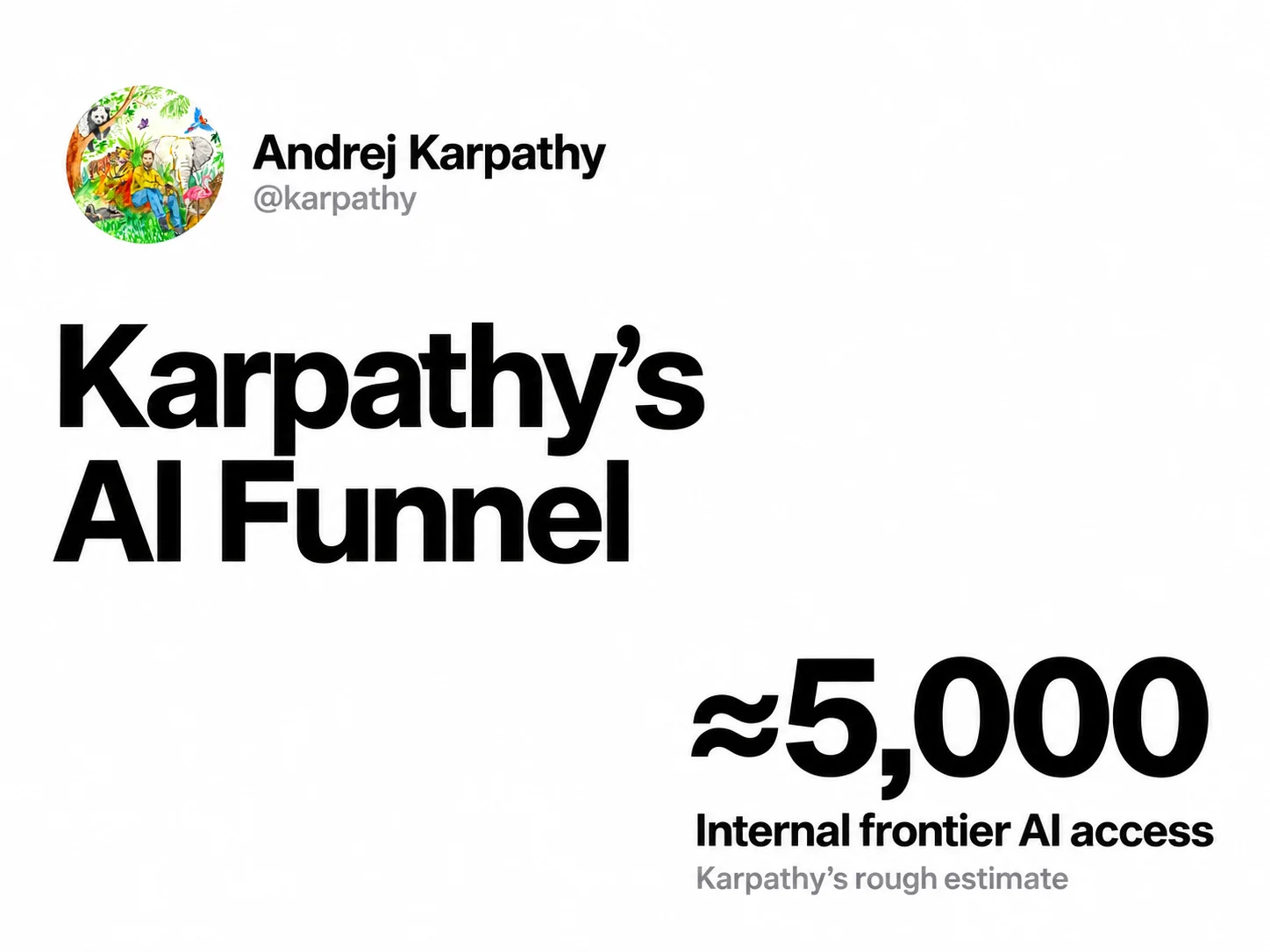

Andrej Karpathy says the gap in how people understand AI capabilities is widening. In a recent X post, he described a sharply narrowing funnel, with roughly 5,000 people worldwide having internal access to frontier AI systems. He presented the figures as informal estimates, rather than measured adoption statistics.
At the broadest end, he estimates around 6 billion people have barely encountered large language models. Another 1–2 billion occasionally use free chatbots, typically for search or writing. Many professionals outside mathematics and programming, he argues, also understand advances largely through secondhand accounts.
The experience changes among an estimated 20 million professional users in mathematics and coding. Karpathy says they see agents tackle complex projects that previously took weeks or months. Inside frontier labs, he describes thousands of agents collaborating over extended periods on software and research tasks. These are his descriptions of capability, rather than independently established success rates.
His latest assessment echoes a December 2025 post, when he wrote about feeling behind as a programmer. He argued that developers now needed to master an additional layer of agents, tools, memory and permissions, alongside conventional software engineering.
This helps explain why some people find AI underwhelming while others say it has transformed their work: they use different tools for different tasks. Karpathy also warns that AI is producing work faster than people can review it. For businesses, getting AI to do more also means making sure someone can check whether it got the job right.