
 ings
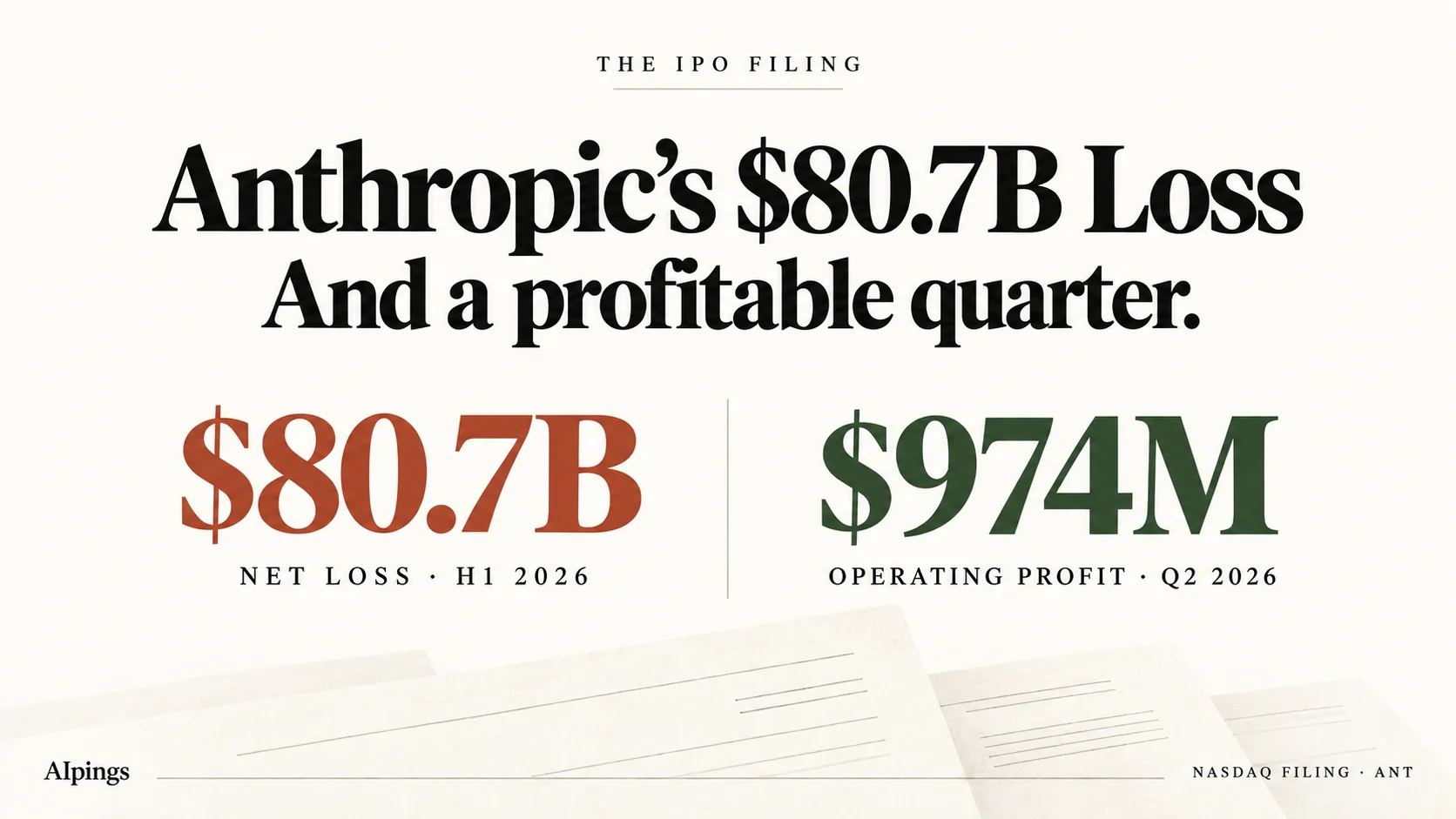
Anthropic’s IPO filing contains a startling contrast: an $80.7 billion net loss in the first half of 2026 and $974 million in operating profit in the second quarter.
The Claude maker announced its IPO filing on October 26, seeking a Nasdaq listing under the ticker ANT, with Goldman Sachs and Morgan Stanley as underwriters.
The Claude maker filed to go public on October 26, seeking a Nasdaq listing under the ticker ANT, with Goldman Sachs and Morgan Stanley as underwriters. The filing offers a detailed look at a business expanding rapidly—and making enormous commitments to keep that expansion going.
Anthropic generated $16.29 billion in revenue during the first half of 2026, roughly 14 times the $1.16 billion it reported a year earlier. Six months of revenue also exceeded its entire 2025 total by more than threefold.
Period | Revenue |
|---|---|
2023 | $41 million |
2024 | $386 million |
2025 | $4.59 billion |
First half of 2026 | $16.29 billion |
Enterprise adoption helps explain the acceleration. By September, more than 11,900 customers had reached the $100,000 revenue threshold, up from just over 950 a year earlier.
Existing customers were expanding their spending, too. Anthropic reported net revenue retention of approximately 900%, meaning revenue from the customer cohort measured by that metric had grown to roughly nine times its previous level.
Claude Code provides a particularly revealing comparison. From July through September, Claude Enterprise users who did not use the coding tool spent less than $75 a month on average. The top 5% of Claude Code users spent approximately $1,500 a month.
The comparison captures the commercial appeal of coding agents: intensive use can generate bills far beyond the price of a standard chatbot subscription.
That growth is beginning to show up in operating results.
Metric | Q1 2026 | Q2 2026 |
|---|---|---|
Revenue | $4.73 billion | $11.56 billion |
Operating income / loss | −$1.67 billion | +$974 million |
Second-quarter revenue rose approximately 144% from the previous quarter. Anthropic moved from a $1.67 billion operating loss to a $974 million operating profit, delivering an 8.4% operating margin.
On an adjusted basis, excluding stock-based compensation and other specified items, operating income reached $2.24 billion, with a margin of about 19%.
The improvement did not entirely erase the first quarter’s losses. For the first half as a whole, Anthropic still reported an operating loss of $693 million.
The much larger net loss came primarily from two financing-related items: $72.39 billion in fair-value losses on convertible notes and SAFEs, and another $8.43 billion in valuation losses on other note-related financial instruments. Interest income of roughly $1.1 billion and other items also affected the final result.
Those instruments can become more valuable to investors as the company’s valuation rises. Remeasuring them can create substantial accounting losses for Anthropic without an equivalent cash outflow.
The distinction matters: the headline $80.7 billion loss is not a measure of cash burn. Anthropic generated approximately $3.9 billion in operating cash flow during the first half.
Its compute spending, however, is substantial—and growing.
Compute and infrastructure spending reached approximately $8.9 billion in the first six months of 2026, already exceeding the $7.3 billion spent during all of 2025.
Anthropic ended June with approximately $131.7 billion in cash, cash equivalents and short-term investments. Its long-term spending commitments put that balance in perspective:
Provider | Reported minimum spending commitment | Through |
|---|---|---|
At least $114.5 billion | 2033 | |
Amazon | At least $110 billion | 2036 |
Microsoft | At least $44.9 billion | 2033 |
These payments extend over years. Even so, the Google and Amazon agreements each approach the size of Anthropic’s June cash and investment balance.
Minimum spending commitments also create a mismatch: customers can adjust their usage, while Anthropic remains bound by contractual payment requirements. Maintaining profitability will depend on filling that capacity with enough paying demand at attractive margins.
Public investors would have limited influence over those decisions.
Under the proposed share structure, an entity formed by seven co-founders would hold a single Class F share carrying 50.1% of shareholder voting power. The Long-Term Benefit Trust would separately hold the right to appoint and remove a majority of directors.
The public offering would consist of Class A shares, leaving governance concentrated through the founder and trust arrangements. The offering price and share count have yet to be set.
Anthropic has now shown that its revenue can cover its operating expenses for a quarter. The next test is whether that $974 million profit can grow as more compute commitments come due and IPO-related stock compensation expenses enter the accounts.